 Child Safety
Dogs and little kids: keeping the family dog and your toddler safe together
Most dog bites to young children come from the family dog or a dog they know, at home. Raising Children Network's free guide and Kidsafe WA's fact sheet show parents when to keep them apart, how to pat a dog safely, and what to do if a bite happens.
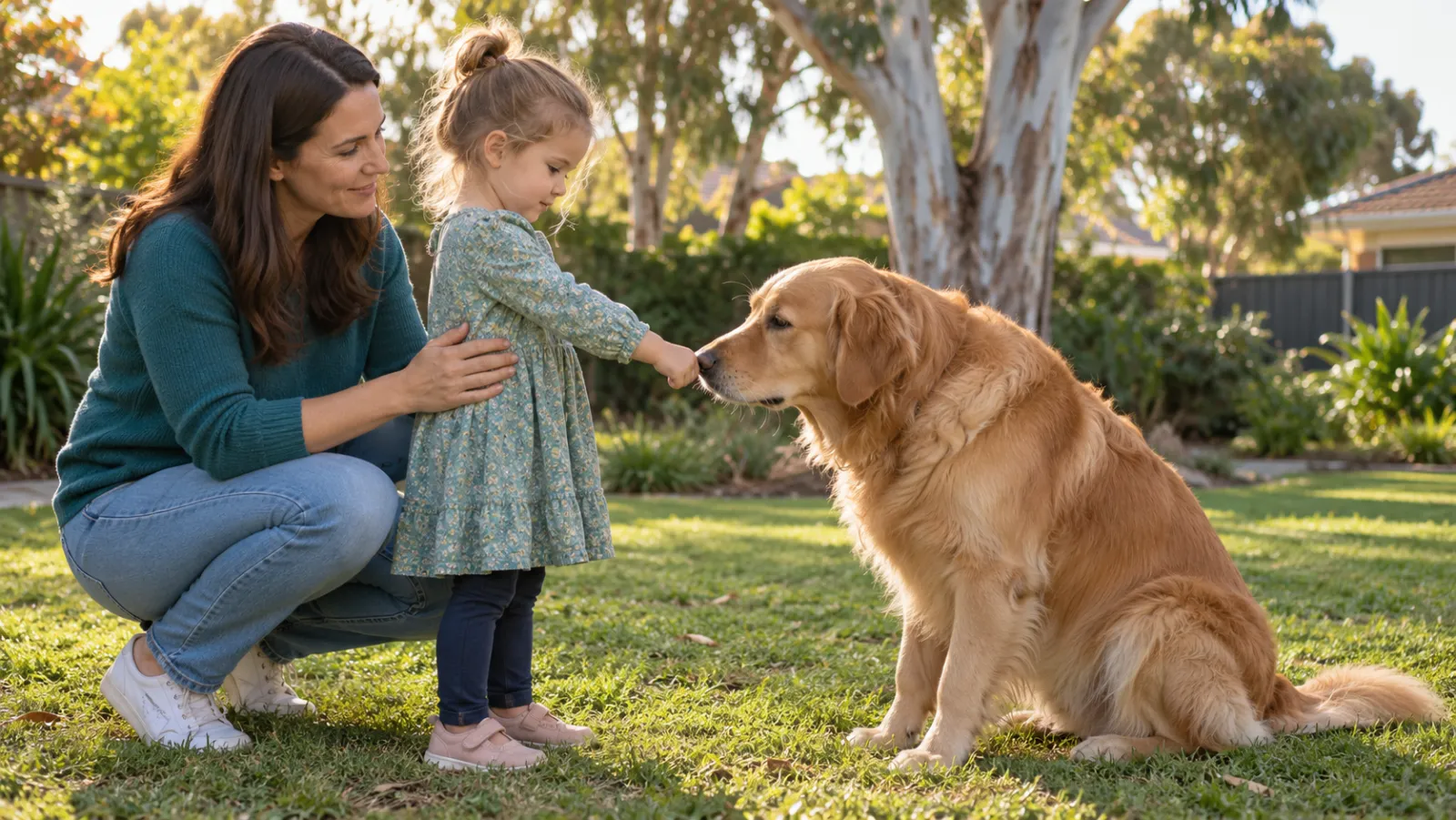
A dog can be a toddler's best friend. Lots of us grew up with one, and want the same for our kids.
The hard part: most dog bites to young children don't come from a stranger's dog at the park. They come from the family dog, or a friend's or grandparent's dog, in or around the home. healthdirect says children under five are among the people bitten most often. Kidsafe WA says the same: under-fives are the most at risk.
None of that means giving up the dog. It means a few habits, and knowing which moments to keep them apart. Raising Children Network has a free, plain guide for parents, checked by a trauma nurse at the Royal Children's Hospital in Melbourne.
Read Raising Children's guide to dogs and children
What it is
Two free resources, no sign-up:
- Dogs and children: preventing child injuries, from Raising Children Network, the Australian Government funded parenting website. It covers supervision, when to separate, patting safely, unfamiliar dogs, and getting a dog ready for a new baby. Last reviewed January 2025.
- Safety around Animals, a one-page fact sheet from Kidsafe WA, the state's child injury prevention charity. It explains why little ones are at risk and adds tips for horses, gardens and bites and stings.
For what to do after a bite, healthdirect's page on dog bites has the first aid.
Who it's for
Any family with a baby, toddler or preschooler and a dog. Also families thinking about getting a dog, parents expecting a baby with a dog at home, and anyone whose children visit a grandparent or friend with a dog.
Why little ones are at risk
Kidsafe WA lists the reasons. Young children are small, so their face is close to a dog's mouth. Their balance is still wobbly. They are curious and can't judge risk yet. And they don't yet know how hard they're squeezing or how loud they are, or how a dog wants to be treated.
Raising Children says the riskiest times are when a child is playing alone with a dog, or trying to play with a dog that's eating or sleeping.
The main habits
Supervise closely. Raising Children means within arm's reach, ready to step in, and not looking at your phone.
Separate when you can't watch. A gate, a door or a separate yard. Also separate them when play gets loud and wild, when there's food around, and when the dog is asleep. Give your child a dog-free zone and give the dog a child-free zone.
Keep them apart at these times, even with a gentle dog:
- The dog is sleeping, eating or chewing a treat.
- The dog is tied up, sick or hurt, or has puppies.
- The dog has taken your child's toy or food. Teach your child to call you, not grab it back.
- The dog is one your child doesn't know.
Only an adult feeds the dog, and the food and water bowls aren't for playing with.
Ask family and friends with dogs to do the same when you visit.
Teach your child to pat a dog
Raising Children's steps, simple enough to practise together:
- Stop three big steps away from the dog.
- Ask the owner, and wait for a yes. Even with a dog you know.
- Walk up calmly, on a curve, not straight at the dog.
- Hold out a closed fist, thumb tucked in, and let the dog sniff the back of the hand.
- Stroke gently along the back, from collar towards tail. Not the head, not the tail.
No hugging a dog around the neck and no kissing: that puts a child's face right by the dog's mouth. No hands through fences.
If a dog your child doesn't know comes up to them, teach them to stand completely still: arms by their sides, hands in fists, quiet, eyes on the ground. If a dog knocks them over, they roll into a ball and keep still.
A new baby and the dog
Raising Children suggests making changes in the months before your baby comes: move the dog's sleeping and play spots, put a gate across the baby's room, shift feeding and walk times, and play recordings of baby sounds around the house. When baby arrives, let the dog sniff a blanket first, greet the dog without the baby, then bring the dog in on a lead once everyone is calm.
Never leave the dog alone with your baby, however well they get on.
If a bite happens
From healthdirect:
- For a small bite, wash around it with soap and running water, pat it dry and cover it with a clean dressing.
- If the skin is broken, see a doctor as soon as you can. They will check for infection and whether your child needs a tetanus shot.
- Go to the emergency department if the wound is large or deep, it's on the face or head, or you can't stop the bleeding. Don't drive yourself: call 000 for an ambulance or get someone to drive you.
- Watch the next few days for redness, swelling, warmth, pus, more pain, or a fever of 38 degrees or more.
Dogs in Australia don't carry rabies.
Not sure how serious it is? Call healthdirect's nurses on 1800 022 222, any hour. More in our post on healthdirect.
What it costs
Nothing. Both guides are free to read and print.
How to use them, step by step
- Open Raising Children's guide (button below) and read the "When to keep dogs and children apart" list. It's the most useful part.
- Walk around your home and yard. Where can the dog go to rest away from the kids? Where can you put a gate?
- Practise the five patting steps with your child, on your own dog first.
- Download Kidsafe WA's one-page fact sheet and stick it on the fridge for grandparents and babysitters.
- Save healthdirect's number in your phone: 1800 022 222.
Read Raising Children's guide to dogs and children
Sources
- Raising Children Network: Dogs and children: preventing child injuries (last reviewed 24 January 2025, Arianwen Woodward, Trauma Clinical Nurse Consultant, The Royal Children's Hospital Melbourne)
- Kidsafe WA: Safety around Animals fact sheet (2023)
- healthdirect: Dog, cat, bat and human bites (who is bitten most, first aid, when to go to hospital, signs of infection)